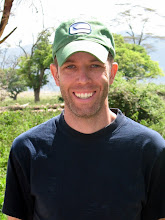
Our journey began early afternoon on Friday, when we met up with three missionaries who were also interested in going. We started the long drive out towards Segou, which is about a three hour drive northwest of Bamako. The drive was uneventful, as far as drives in Mali go. You have to watch out for stray cattle or sheep on the road, the occasional huge pothole, and any daredevil bus or truck drivers. At least the roads here are pretty smooth, which was something we never enjoyed in Congo. We made good time getting to Segou, checked into a hotel for the night, and had dinner at a restaurant on the Niger.
The next morning we left around 5:30 to drive the rest of the way to tiny town of Diafarabe. The first half of the drive was on paved roads until we got to a village and were directed, by way of a GPS and a local villager, down what looked like someone's back alley. This led us to a long, rough road which was pockmarked with lots of hoofprints and had plenty of clouds of dust. After an hour or so of teeth-rattling and butt-numbing off-roading, we arrived at Diafarabe. A tent had been erected on the south bank of the river, near where the cattle would be going ashore, and a few dozen people were already starting to gather.
We paid a guy to take us across the river in his boat. I'm sure he made out like a bandit that day, since he spent most of his day transporting tourists back and forth across the river.

Here's a shot of us approaching the bank - the water was very deep on this side of the river, well over eight feet. The lady with her back to the camera handled most of the driving for the trip, Judy "Crash" Miller. I was very glad to not have to handle the driving since it's pretty tiring. To the left, you can see the tent that was put up for all the dignirities to sit under, and on the right you can see people who have already started to gather for the crossing.


As the time grew near for the crossing to begin, the crowds started to grow. Everyone claimed a spot on the riverbank. Note that the riverbank on our side was pretty steep, with a drop of a good six or eight feet to the river below. On the other side of the river, where the cattle were starting from, there was a more gradual slope into the Niger.

One thing that was kind of weird about the event was that the locals were sectioned off from the tourists such as ourselves who came to watch. Malian security guards were there to keep people in their own sections. The "white person" section ended just past the white people you see below.

Here's a shot of our traveling companions - myself along with Alison, Rita, and Judy. These people know how to travel in style. They brought camp chairs, a giant cooler, some Twizzlers, Fig Newtons, handi-wipes, plastic tableware... all kinds of great stuff. Heck, I never traveled this well-prepared in America.

Here's a photo from our vantage point, looking across the river at the cattle getting ready to cross.

The crossing began around 11am or so. Fulani would gather their herds of cattle on the northern bank of the river and each herd would wait their turn to make the crossing. Each group would wade in, cattle and herders together, and they would drive their cattle into deeper and deeper water until they were all swimming. The river's current would carry them downstream and they'd eventually land on the banks near where we were sitting.
Here's the first group in the water - notice other herds lining up behind them on the banks.

The men in the boats would help drive the cattle across, but the guys in the water were doing most of the hard work.


In this photo below, you can see a couple of Fulani in the water with their cattle. A lot of Africans don't know how to swim, and I would imagine that being a cattle herder provides one with even less opportunities to learn how it's done. Yet these guys were in there, swimming their way across a river, being careful to not get crushed/kicked/gored by a cow, and they also had the wherewithal to beat the cows with one free hand in order to keep them all swimming in the same direction.

Finally, they made it ashore. I have no idea why the cow on the right has a blue ribbon around its neck. I'd like to think it was to show that he won the prettiest cow competition, but I learned that was held after all the cattle had crossed the river, so who knows what it was for.


The cattle all made their way up the side of the bank and past the assembled crowd. They didn't seem too worse for wear beside some annoyed-sounded mooing, and at least they all got a good rinsing out of the trip.


From here it was on to greener pastures, further south.

This little guy was too small to make the trip through the water, so he got to ride over on a boat with one of the herders. Next year, pal. Just wait till next year. We'll see how easy your life is when you're swimming across the Niger while a crazed Fulani beats you with a stick.

Finally, here's what I consider one of the best pictures taken of me in Africa. This little girl had a million questions for us about our cooler, chairs, and who knows what else. I don't speak the local language, so we communicated with a lot gestures. We took out the camera to get a picture of her but she wasn't too interested in looking at the lens. Booger, though, who was standing behind her, looks like he's about ready to kill somebody.

We only stayed until about 1:00 - we had a long, long drive back to Bamako and there were still several hundred cows who needed to cross the river. It was a six hour drive back home (three hours to Segou, and then another three back to Bamako) and we got home just after 7pm.
In other news, my gig as a high school math teacher is finally over after three weeks. The school found a retired math teacher who will come in and teach for the rest of the school year. This week, it's back to looking for contract work online as well as getting ready to come home for Christmas. It's hard to believe, but I'll be getting on a plane three weeks from Friday. I'm excited.